
Satellite IoT is entering a phase where points of difference extend beyond just connectivity. While satellite networks remain critical in connecting assets beyond the reach of terrestrial networks, the question now turns to how well providers can connect devices, integrate with terrestrial networks and enable enterprises to scale their deployments.
As established satellite IoT providers expand their propositions while newer players bring satellite connectivity closer to the cellular ecosystem, the market is becoming less about satellite coverage and more about what surrounds it. Devices, modules, standards, mobile network operators, applications, partnerships and commercial execution are all becoming part of the competitive equation.
Satellite IoT moves beyond niche connectivity
Satellite IoT has traditionally addressed an obvious requirement: connectivity of remote assets where terrestrial networks are unavailable or unreliable. While this holds true across transport, maritime, agriculture, mining, energy, utilities and environmental monitoring, satellite is becoming part of a wider connectivity architecture rather than a standalone solution for remote assets.
Three key developments are shifting the market to embrace satellite as a broader enabler.
- 3GPP NTN is bringing satellite closer to the cellular ecosystem to make it easier to use satellite alongside existing IoT devices and networks.
- Hybrid satellite cellular connectivity is also gaining significance, where devices can leverage both terrestrial networks where available and satellite when out of coverage.
- The ecosystem is broadening beyond the traditional satellite players into mobile operators, chipset and module vendors, along with device makers and IoT platforms. Collectively, this is driving towards satellite being part of the IoT connectivity stack rather than a standalone option for remote assets.
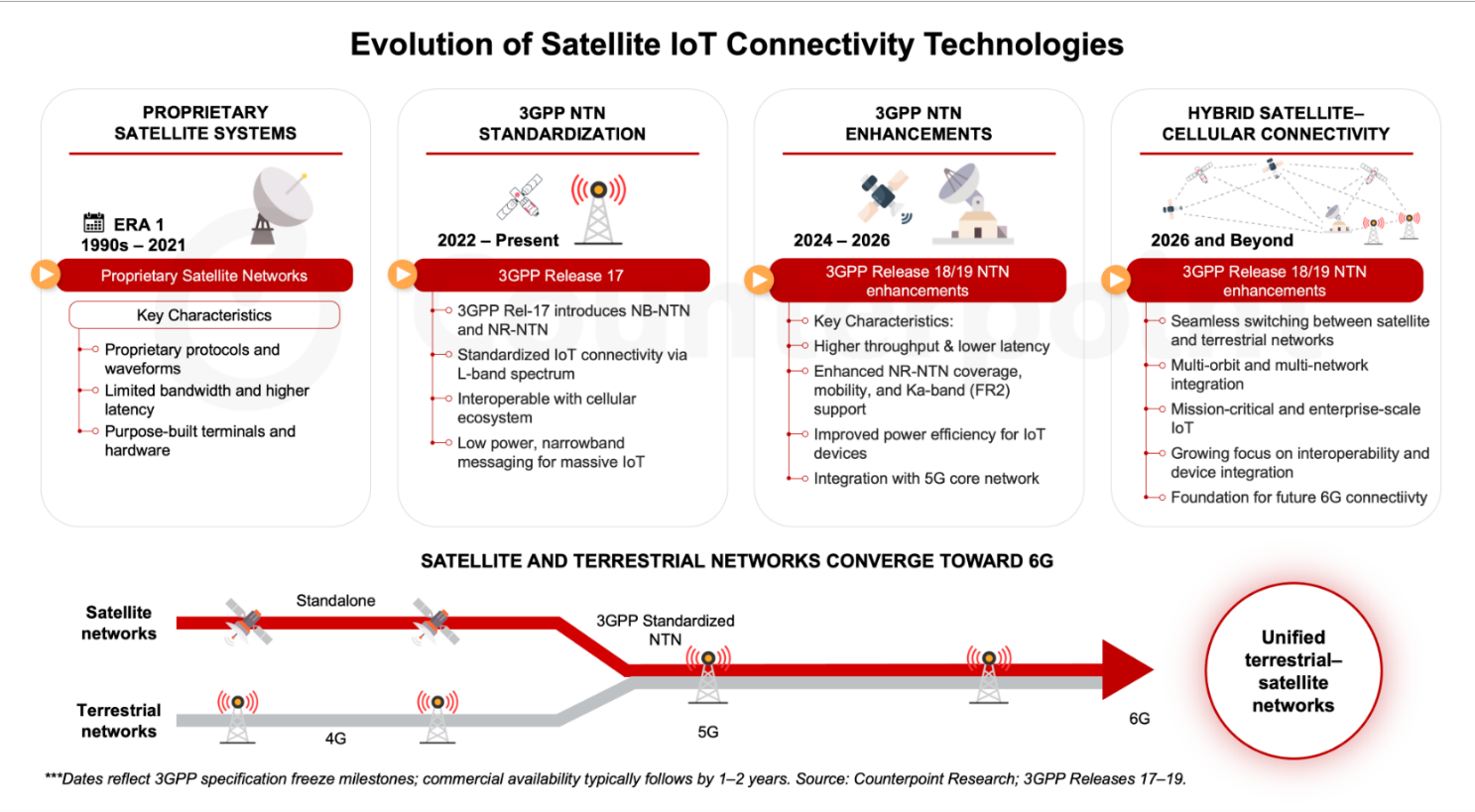
The shift is evident in how providers are shaping their propositions and partnerships, with standards-based NTN enabling this convergence and hybrid architectures allowing satellite and terrestrial networks to work together rather than as separate layers of connectivity.
Skylo is an example of this transition, with the brand’s proposition grounded on standards-based NTN and convergence with the existing cellular ecosystem. Its partnership with Vodafone IoT sees the integration of its network cores that enable compatible devices to switch between cellular and NTN connectivity using a single SIM.
Convergence is also being driven by standards-based device connectivity. Sateliot’s network is based on 3GPP NB-IoT NTN, and its partnership with Telenor IoT aims to enable compatible NB-IoT devices to transition between terrestrial and satellite networks without requiring proprietary satellite hardware, thereby broadening the reach of satellite connectivity to the existing cellular IoT ecosystem.
Established providers are also broadening their propositions to include hybrid and standards-based connectivity. Iridium is adding hybrid and standards-based features to its established satellite IoT business, with the Iridium 9604 combining satellite, LTE-M and GNSS in a module, and its NTN Direct roadmap. Viasat, on its acquisition of Inmarsat, has also broadened its satellite portfolio to encompass Inmarsat’s IoT Nano service built upon Inmarsat’s existing narrowband IoT capabilities.
ORBCOMM is extending its industrial IoT proposition through SkyWave and hybrid satellite cellular connectivity, and Globalstar is moving beyond its traditional tracking offerings with the two-way RM200M module. Similarly, Myriota is combining its low power satellite proposition with cellular connectivity through HyperPulse.
The common theme is that although not all players are adopting the same technology, satellite connectivity is becoming more enmeshed in the wider IoT stack from networks, devices, platforms and enterprise connectivity. This is broadening the role of satellite from specialist solution for remote assets to being an adjunct within wider IoT deployments.
The satellite IoT market is entering a new competitive phase
This technology shift is opening a much larger market opportunity. According to Counterpoint Research’s Global Satellite IoT Connectivity Market Forecast, global satellite IoT connections are expected to grow from around 8 million in 2025 to more than 80 million by 2032, reflecting how satellite connectivity is moving beyond the specialised market for remote assets and into a much broader IoT opportunity.
However, most satellite IoT connections today still run on proprietary satellite networks, while standards-based NTN is gaining momentum.
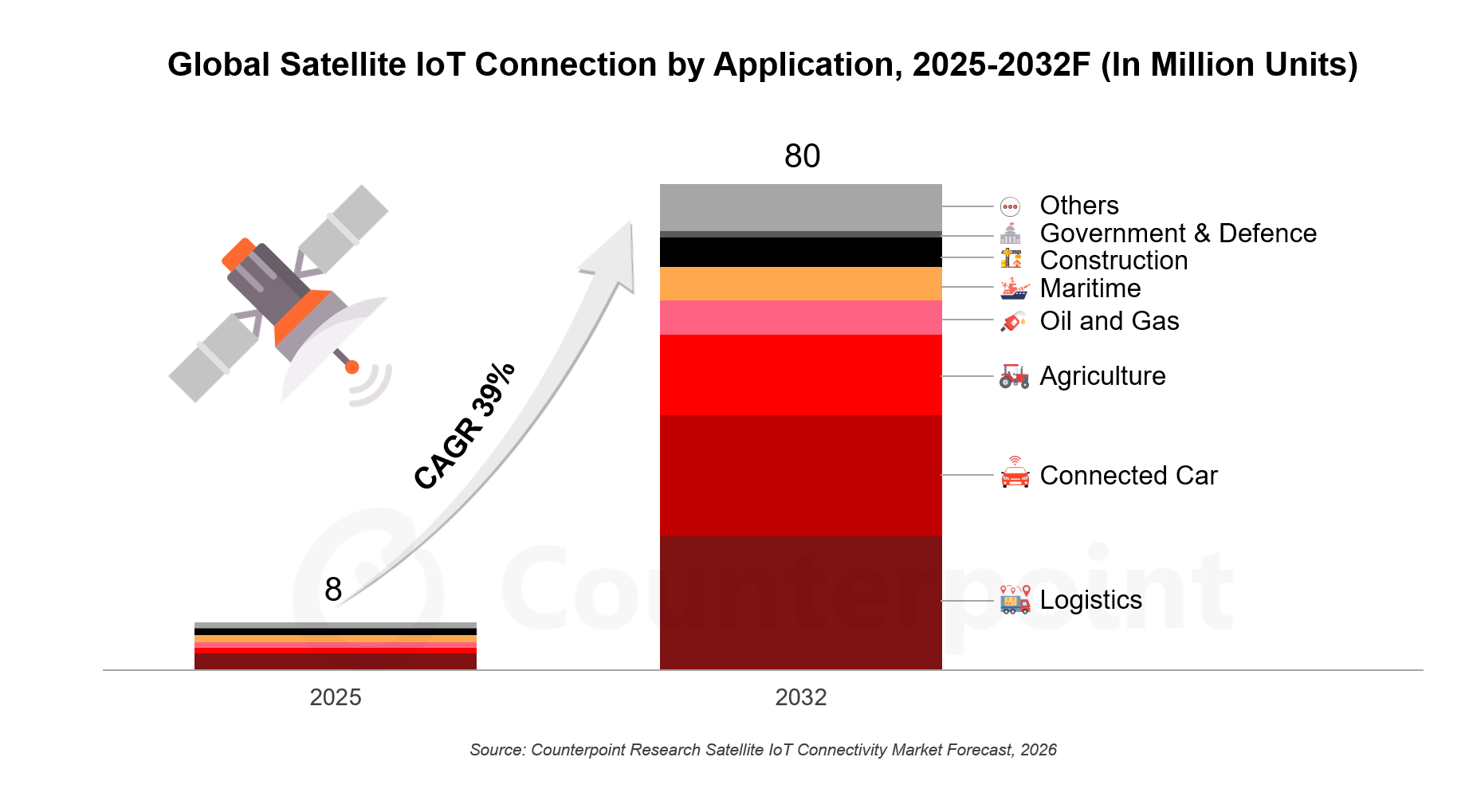
There are multiple factors that will contribute to this growth trajectory.
- 3GPP NTN standardisation will reduce the satellite-specific component in IoT devices.
- Declining module prices and satellite-specific costs will allow for a broader adoption of satellite connectivity.
The application opportunity is broadening at the same time. Logistics is seeing demand for satellite connectivity to track containers, trailers and other assets beyond terrestrial coverage while agriculture is creating opportunities to connect livestock trackers, farm equipment and remote sensors across areas with limited cellular coverage. Automotive represents a longer-term opportunity as satellite connectivity becomes more closely integrated with connected vehicle architectures, particularly for emergency and safety-related applications.
The market is consequently attracting providers with very different starting points. Established operators such as Iridium, Viasat, ORBCOMM and Globalstar bring existing networks, customers and deployment experience. Newer players such as Skylo, OQ Technology, and Sateliot are targeting the market from different angles and leveraging novel approaches such as NTN standardisation, hybrid solutions, partnerships with mobile operators, and alternative hardware designs. This makes the competitive landscape more complex and nuanced than it may seem at first glance. Ultimately, the question of which company will be positioned to capture the largest share of the satellite IoT market will require a closer examination of the competitive dynamics and nuances of each player’s approach.
Counterpoint’s satellite IoT connectivity CORE rankings 2026
Counterpoint’s Satellite IoT Connectivity CORE Rankings evaluate providers of satellite IoT in terms of capabilities and execution level required to compete as the market grows. The assessment looks beyond satellite coverage to consider the broader factors that determine a provider’s ability to enable and scale IoT.
The assessment considers network and technology capabilities, performance and reliability, scalability and operational readiness, device ecosystem and deployment, platform and integration, regulatory readiness and market execution. These parameters capture the underlying strength of each proposition and how effectively providers are translating those capabilities into the market.
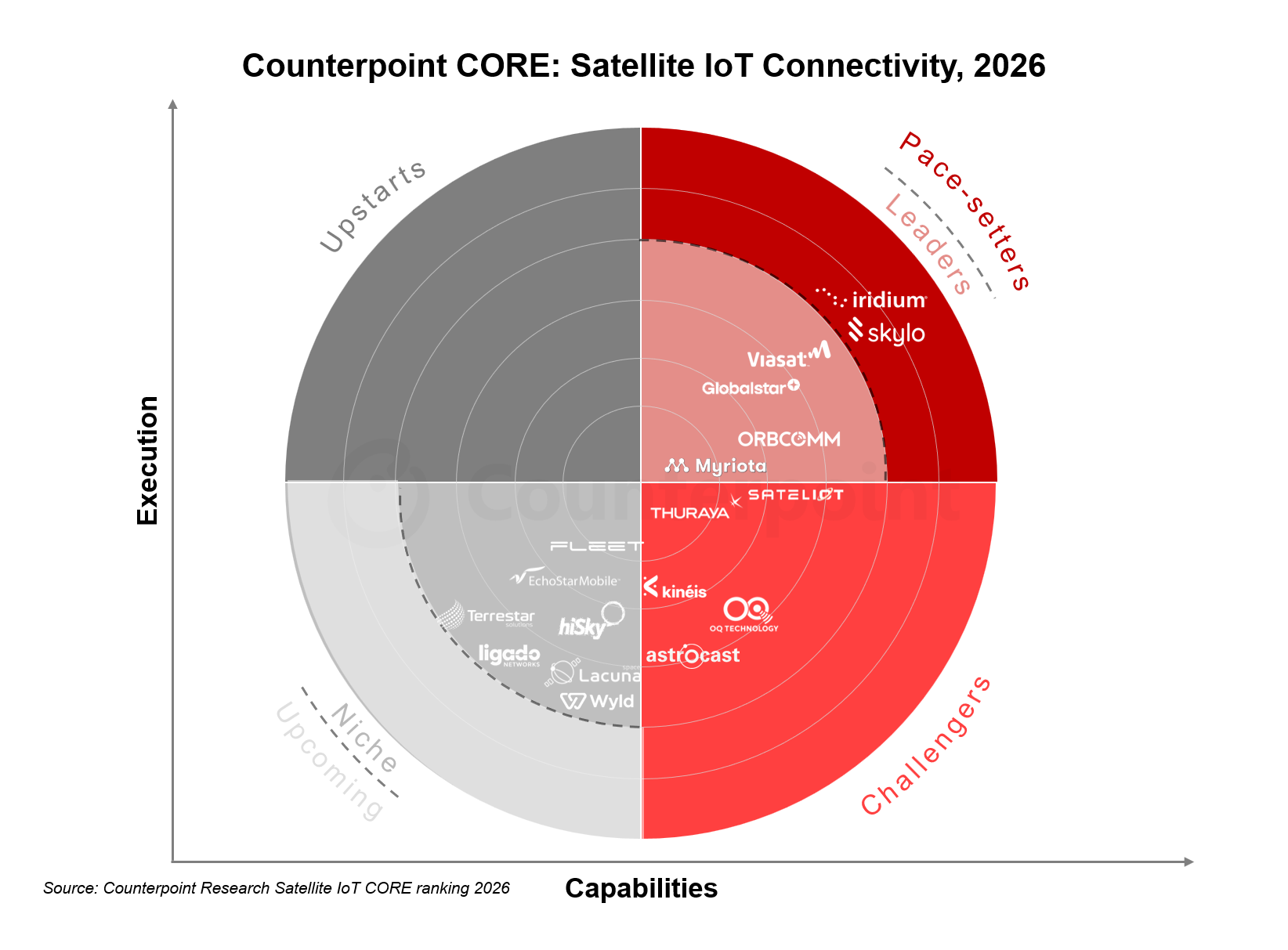
The results place providers across six categories. Pacesetters combine strong capabilities with broad execution across the market. Leaders have established positions and well-rounded capabilities, while Challengers show significant strengths with further potential to build scale and market reach. Upstarts are at an earlier stage with a good approach to market but still adding capabilities to offerings that could gain importance as the market develops. Niche players have established defensible positions through specialised technologies, vertical expertise or regional advantages.
In Counterpoint’s 2026 CORE assessment, Iridium and Skylo emerge as the Pacesetters, although their strengths come from different positions in the market. Iridium combines a mature global LEO network, an established IoT base and broad partner ecosystem with continued investment in hybrid and standards-based connectivity. Its Iridium 9604 and NTN Direct roadmap extend its opportunity across new device architectures and standards-based connectivity. Meanwhile, Skylo is pushing the market toward standards-based NTN through deep integration with mobile operator, chipset and device ecosystems.
Viasat occupies a different position. The combination of Viasat and Inmarsat gives the brand considerable breadth across satellite connectivity and established enterprise markets. The acquisition also brought together complementary network assets and an existing narrowband IoT business, providing a broader foundation from which to address the satellite IoT opportunity.
ORBCOMM and Globalstar stand out for the depth of their existing IoT businesses. ORBCOMM’s long-standing focus on industrial applications gives it strong deployment experience and an established route to enterprise customers, while Globalstar is building on its tracking heritage as it expands its two-way IoT proposition.
Further across the ranking, Myriota and Sateliot illustrate how more focused technology strategies are creating alternative routes into the market. Myriota is extending its established low-power proposition into newer hybrid architectures, while Sateliot is pursuing a standards-led model closely connected to the mobile ecosystem.
What separates the leaders from the challengers?
- Narrowing gap – The CORE assessment shows that the gap between leaders and challengers is narrowing in terms of connectivity capabilities. As the market develops, execution is becoming an equally important differentiator.
- Areas of differentiation – Three areas – device integration, interoperability and commercial execution – differentiate challengers from leaders. Device integration is becoming important as satellite connectivity moves closer to the cellular ecosystem, while interoperability will determine how easily devices can operate across terrestrial and satellite networks. Commercial execution is equally critical, covering partnerships, distribution, customer support and the ability to turn technology into repeatable deployments.
- Incumbent advantage – This is where established providers have an advantage through existing deployments and customer relationships, while standards-led providers can compete by making satellite connectivity easier to integrate into the broader IoT ecosystem. Ultimately, the ability to combine technology with ecosystem strength and commercial execution will determine who can scale.
Looking ahead: what will shape market leadership?
As satellite IoT moves toward larger enterprise deployments, the leaders will be those that can turn technical capability into products that are easy to deploy, integrate and scale. The value of hybrid connectivity will be particularly important for applications such as logistics, agriculture, utilities and industrial equipment, where devices can use terrestrial networks where available and satellite beyond coverage. The market is still at an early stage of development, giving established providers an advantage through network scale, installed deployments and commercial experience. At the same time, standards-led providers are creating new routes into the broader cellular IoT ecosystem. As adoption expands, the competitive landscape is likely to evolve, with future leadership depending increasingly on deployment scale, ecosystem strength, interoperability and ease of integration, rather than connectivity capability alone.
Conclusion
The satellite IoT market is still in an early stage, with more players expected to join the momentum, as they complete their portfolios implying more competitive market dynamics. The market opportunity is significant, with satellite IoT connections expected to grow 10x in seven years. Nevertheless, finding the right execution strategy and partnerships will be crucial. Pacesetters are expected to continue pioneering based on their foundations, challengers and leaders are expected to see much tighter competition as providers try to play to their strengths and attract more customers.
The author is Subhadip Roy, analyst at Counterpoint Research.
Comment on this article via X: @IoTNow_ and visit our homepage IoT Now