The connected car is becoming a software-defined vehicle: a platform that improves through software upgrades throughout its life. The number of these vehicles is climbing quickly: Analysys Mason expects the worldwide base of connected vehicles to reach 830 million by 2030.
Connectivity is the foundation for the shift, but the ground beneath it is moving. Three changes in particular are redrawing what vehicle manufacturers (OEMs) need from connectivity: a steep rise in data usage, the shift to eSIM and the expanding rollout of 5G. OEMs need to understand these changes and ensure they are equipped to respond to them effectively.
A fourfold rise in data makes visibility the key to controlling costs
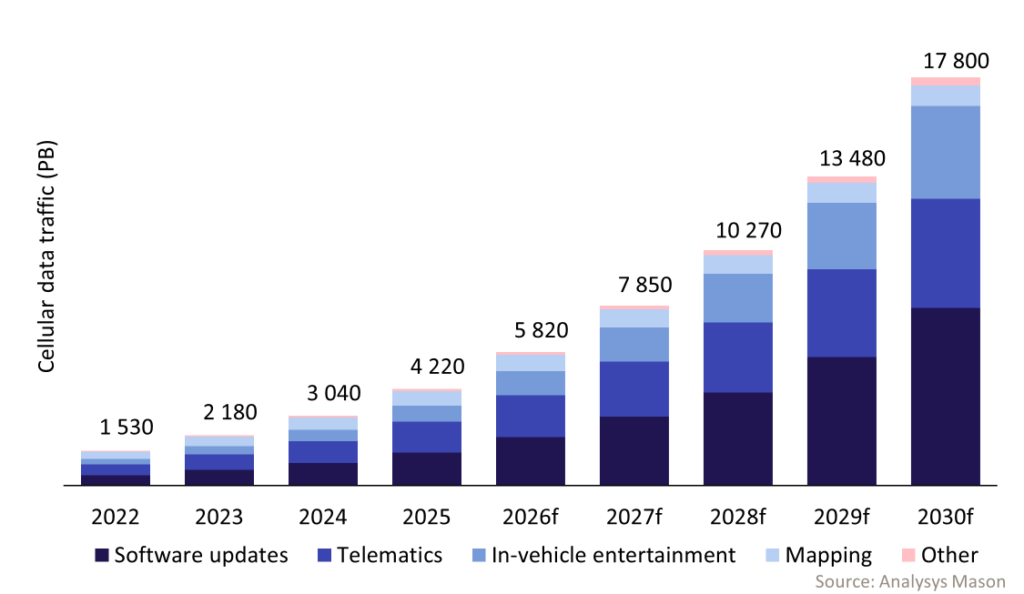
Analysys Mason forecasts that connected car cellular traffic will increase fourfold between 2025 and 2030, reaching roughly 22GB per connected vehicle per year by 2030. As Figure 1 shows, this growth will be driven by the evolution of connected car applications, particularly software updates and in-vehicle entertainment.
Figure 1: Connected car cellular traffic by application, worldwide
Electric vehicles (EVs) add to the pressure: they will account for more than 40% of new car sales by 2030 and rely more heavily on software updates, remote diagnostics and app-based services such as charging and battery management. EVs therefore consume several times more data than a comparable internal combustion engine (ICE) car.
Left unmonitored, the surge in data traffic could bring unpredictable costs and performance risk for OEMs. Operational visibility into their networks gives OEMs a unified view across vehicles and applications, letting them identify unusual data usage and contain usage spikes before they spread across the fleet. It allows OEMs to control costs, support accurate billing and ensure that critical applications such as telematics and software updates continue to operate reliably.
SGP.32 presents new markets and new operational challenges for OEMs
SIMs with remote-provisioning capabilities are replacing physical SIMs that are locked into a single operator. The shift will accelerate thanks to the recent introduction of SGP.32, a new eSIM specification optimized for IoT. SGP.32 will finally deliver on the promise of eSIM by enabling profiles to be provisioned and switched entirely over the air, making remote profile management practical across large fleets.
SGP.32 gives OEMs greater flexibility to deploy connected services globally, but it also increases the complexity of managing them. As vehicles move between countries and networks, OEMs need deep visibility into connectivity performance, profile status and network selection across their fleets. Such visibility helps OEMs identify where vehicles are operating, ensure devices remain connected to the most appropriate network and maintain security and a consistent customer experience regardless of location.
5G unlocks new services and raises the bar for managing them
5G offers higher bandwidth and lower latency than 4G, enabling new use cases. It makes large software updates faster and more dependable, supports high-definition streaming for passengers and underpins real-time services such as live mapping and advanced driver-assistance features.
In time, 5G will be increasingly used as the enabler for vehicle-to-everything (V2X) communication, letting cars exchange information with each other and roadside infrastructure to improve safety and traffic flow. Each of these services asks more of the connection, so OEMs need more advanced tools on their connectivity management platform to understand network behavior and keep services reliable.
The software-defined vehicle demands visibility beyond connectivity
The rise of the software-defined vehicle is transforming connectivity from a supporting function into a strategic capability. As data consumption grows, eSIMs make connectivity more dynamic locally and 5G enables richer connected services, OEMs need greater visibility and control across their fleets. Understanding how vehicles, networks and applications are performing in near real time will be critical for controlling costs, maintaining service quality and delivering the seamless connected experiences that customers increasingly expect. OEMs that can combine connectivity management, operational visibility and security into a single intelligent approach will be best positioned to scale software-defined vehicles profitably.
About Aeris
For more than three decades, Aeris has been a trusted cellular platform leader enabling the biggest IoT programs with innovative technologies and borderless connectivity that simplify management, enhance security, optimize performance and drive growth at scale. Our IoT technology expertise serves a global ecosystem of 7000 enterprise customers, nearly 30 mobile network operator partners and 104 million IoT devices across the world. Today, we support 70 automotive programs across 45 vehicle brands and 30+ global automotive OEM groups. Aeris IoT WatchtowerTM, a fully integrated capability on the Aeris IoT Accelerator platform, gives automotive OEMs a single operational view across vehicles, networks and applications, delivering the network-level insights and enforceable security controls needed to simplify operations, improve efficiency and support profitable growth. As the largest orchestrator of eSIMs for IoT, we power today’s connected smart world. To learn how Aeris IoT Accelerator Platform, Aeris IoT Watchtower and Aeris Mobility Suite can secure and supercharge your critical IoT programs, visit aeris.com and follow us on LinkedIn.