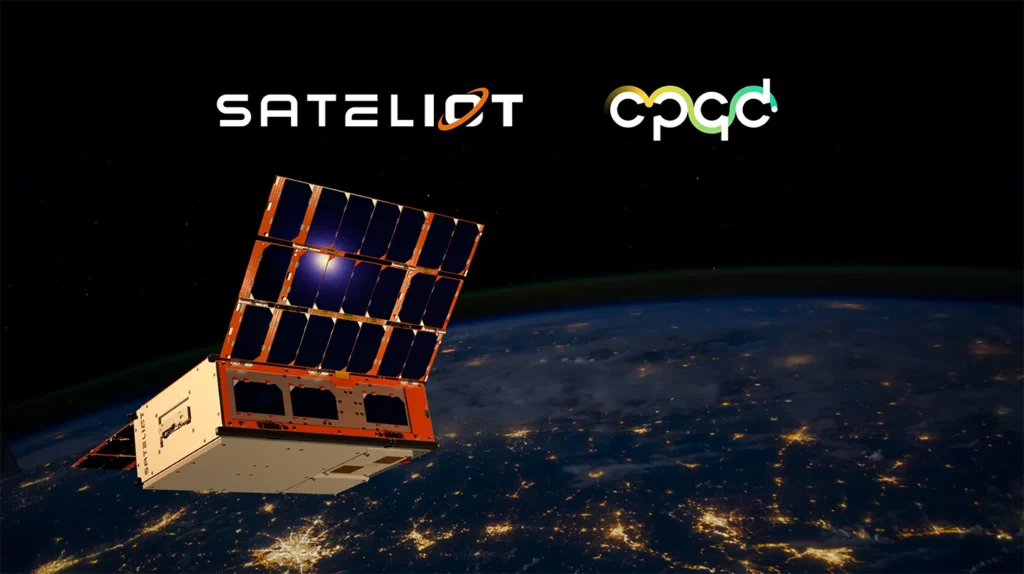
The first commercial demonstration of connectivity on a Non-Terrestrial Network (NTN) has been completed for the first time in Brazil, as a result of the partnership between European telecommunications company Sateliot and CPQD, one of Brazil’s innovation centres. The test validates both the performance and commercial viability of Internet of Things (IoT) services using satellites in areas without terrestrial cellular coverage.
The demonstration, carried out in a remote location with no cellular coverage, validated Sateliot’s hybrid connectivity model, compatible with the 3GPP standard. The technology allows standard NB-IoT devices – a type of wireless communication designed for low-power devices handling low data transmission rates – to connect via satellite without any modifications.
This marks a step in Brazilian telecommunications, as the test confirms the feasibility of seamless roaming between terrestrial and satellite networks, representing a significant step toward mass IoT adoption in rural areas of Brazil without connectivity.
Enabling IoT beyond terrestrial limits
The test is part of Conecte o Brasil LEO NTN, an initiative led by Sateliot to accelerate the certification, testing and adoption of low Earth orbit satellite technologies in Brazil. The program has been used to validate devices, ensure interoperability, and support ecosystem readiness for IoT services using NTN technology. It is open to all IoT solution providers in Brazil interested in exploring the potential of this connectivity. The proof of concept, conducted by CPQD, validates a low-power satellite IoT device for cattle tracking in areas without terrestrial coverage, advancing the digitalisation of extensive livestock farming in Brazil.
By using standard protocols, the solution eliminates the need for proprietary hardware or complex integrations, lowering the barriers for companies looking to implement IoT solutions in sectors such as agriculture, utilities, logistics and environmental monitoring.
Industry and market relevance
Brazil represents one of the largest untapped IoT markets in the world, particularly in sectors operating in remote environments or with limited infrastructure. Despite strong growth in cellular IoT, large portions of the country remain beyond the reach of traditional networks.
This validation demonstrates how NTN networks can complement existing infrastructure, enabling nationwide coverage and supporting digital transformation initiatives across key sectors.
“This first commercial demonstration in Brazil is a crucial milestone for Sateliot and for the entire NTN ecosystem,” says Gianluca Redolfi, the CCO of Sateliot. “We have proven not only that the technology works under real conditions, but also that it can be deployed using standard devices and operators’ existing infrastructure. This is essential for scaling IoT connectivity globally.“
“With NTN, we have been able to extend the reach of IoT applications and enable new operating models for various sectors of the economy,” says Elitelma Souza, the solution manager for automation, IoT and hybrid computing at CPQD. “Our collaboration with Sateliot through the Conecta Brasil LEO NTN program demonstrates how terrestrial satellite networks can work together to expand connectivity and open up new opportunities for Brazilian industries.”
Comment on this article via X: @IoTNow_ and visit our homepage IoT Now